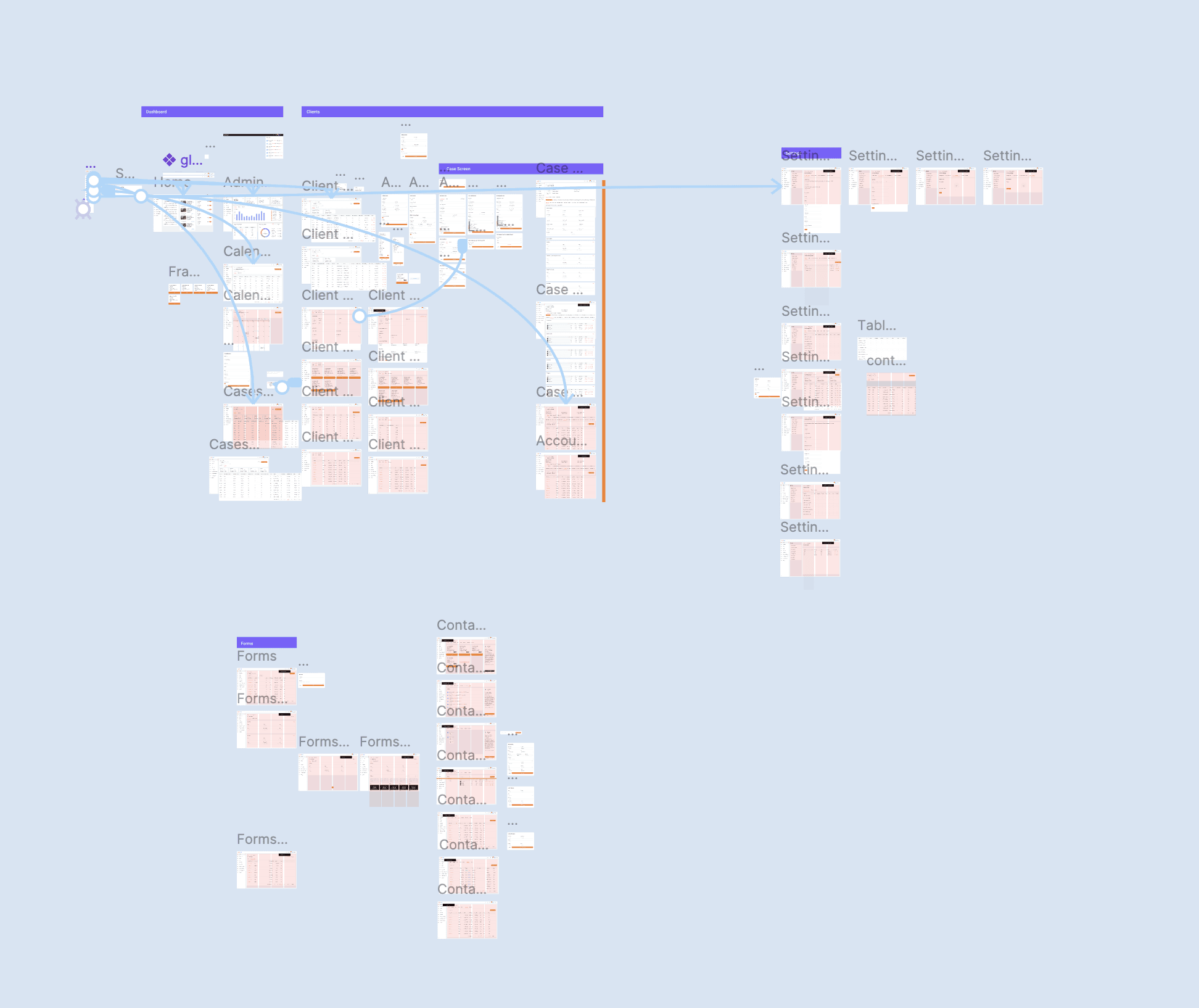


A compliance-first tax, land, and legal operations platform designed for complex regulatory workflows.
Context
LexLedger was built to support tax filing, land records, and legal workflows within highly regulated environments. The platform was conceived and shaped by domain experts with deep government and compliance experience, including retired officials who understood how these systems work in reality.
The scope went far beyond tax filing. It involved managing interconnected legal records, sanctions, approvals, and compliance processes that typically live across fragmented tools, departments, and paper-driven systems.
The Problem
The core challenge was complexity with zero tolerance for error.
Compliance systems are unforgiving. Mistakes don’t just slow things down - they can invalidate filings, delay approvals, or trigger regulatory issues.
Key problems included:
Highly interdependent legal and tax workflows
Government-specific processes and terminology
Multiple approval layers and document dependencies
Long-running cases with evolving states
The need for auditability and traceability at every step
The system had to balance rigour with usability, without oversimplifying reality.
Key Constraints
Regulatory processes that could not be redesigned or simplified arbitrarily
Legal records requiring strict versioning and history
Government integrations and documentation standards
Multiple user roles with tightly scoped permissions
Long lifecycle cases spanning months or years
Every decision had to respect institutional constraints.
The System We Designed
LexLedger was designed as a structured compliance system, where workflows, data, and permissions were tightly controlled but still usable.
Core system principles:
Compliance before convenience
Clear state transitions across workflows
Full traceability of actions and changes
Role-based access aligned with legal responsibility
What the system included:
End-to-end tax filing workflows
Land and legal record management
Sanction and approval tracking
Case-based document handling
Audit logs and compliance reporting
Rather than automating everything, the system focused on making complex processes reliable and repeatable.
Decisions That Mattered
1. Respect existing regulatory structures
We designed around real-world legal processes instead of forcing artificial simplifications.
2. Make states explicit
Every case moved through clearly defined stages, reducing ambiguity and errors.
3. Treat auditability as a feature
Logs, history, and traceability were core to the system - not afterthoughts.
4. Design for longevity, not speed
The platform was built to handle long-running cases without losing clarity over time.
Our Role
We worked across:
System and workflow design
Experience architecture for regulated users
Permission and role modelling
Execution support across complex modules
Our focus was ensuring the system stayed legally sound as it scaled in scope.
Outcomes
Centralised management of tax, land, and legal workflows
Reduced errors and ambiguity across compliance processes
Clear audit trails and accountability
A platform capable of supporting complex, long-term cases
LexLedger became a single source of truth for regulated operations.
Why This Matters
Compliance systems don’t need to be fast, they need to be right.
LexLedger demonstrates how systems-first thinking can bring structure and clarity to environments where accuracy, traceability, and governance matter more than speed.